| CLICK HERE FOR INDEX PAGE | |
| CAMS and FOLLOWERS | |
| V. Ryan © 2002 - 2020 | |
| PDF FILE - CLICK HERE FOR PRINTABLE WORKSHEET | |
|
Have you ever looked closely at a simple mechanical
toy ? If you have the opportunity to study one closely you will see that
it is made up of mechanisms, usually including CAMS. |
|
|
|
A CAM changes the input motion, which is usually rotary motion (a rotating motion), to a reciprocating motion of the follower. They are found in many machines and toys |
|
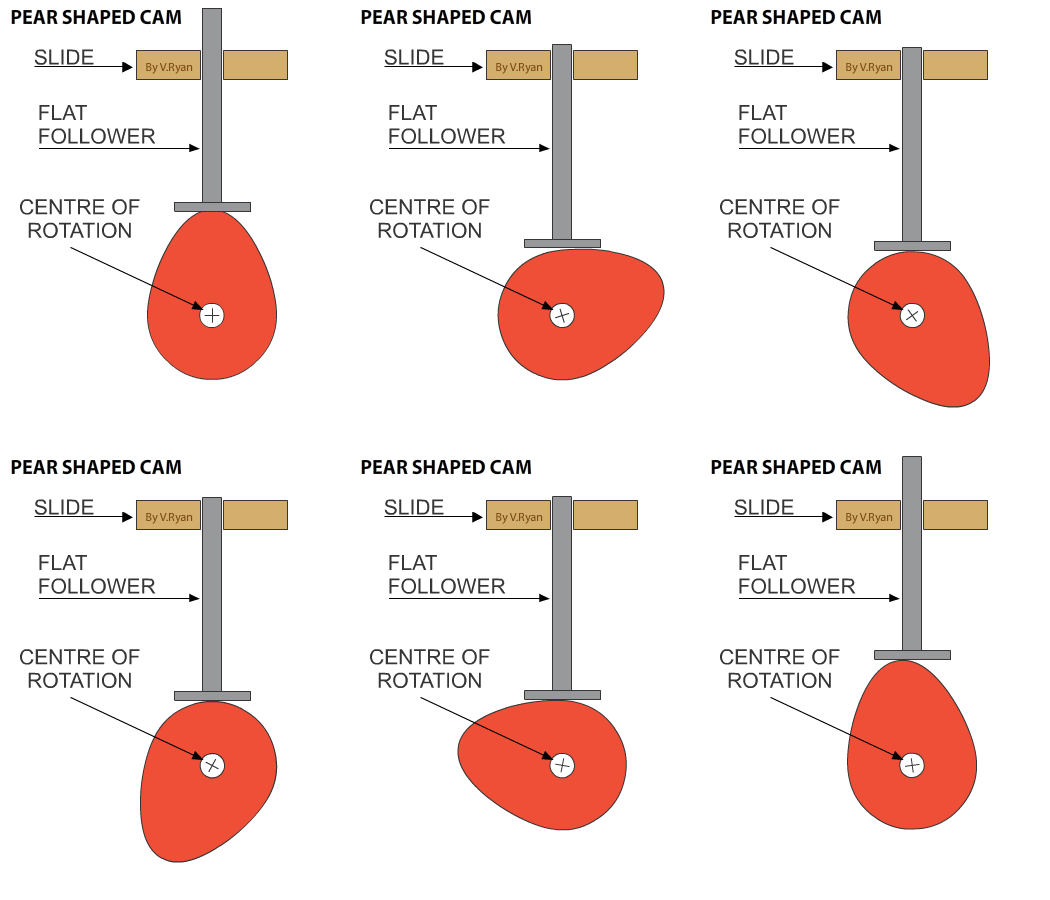
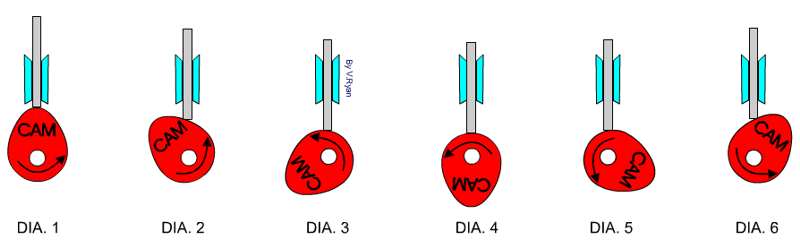
A CAM has two parts, the FOLLOWER and the CAM PROFILE. Diagrams one to six show a rotating cam pushing a follower up and then allowing it to slowly fall back down. |
|
 |
|
|
In diagram 1 the cam is in a vertical position and it slow rotates in an anticlockwise direction. As it rotates the follow drops down. In diagram 4 the follower is in its lowest position. The cam continues to rotate and the follower begins to rise in diagrams 5 and 6 until it returns to its original position. |
|
|
KEY PHRASES |
|
| ONE CYCLE | One rotation/revolution of the cam. |
| DWELL |
When the cam rotates but the follower does not rise or fall. |
| THE RISE |
That part of the cam that causes the follower to rise. |
| What do you think is the 'FALL' ? | |
|
TYPES OF FOLLOWER |
|
|
|
|
|
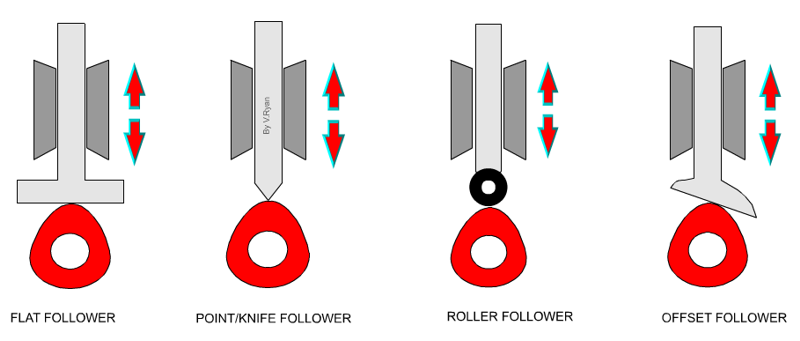
There are different types of follower but they all slide or roll on the edge of the cam. Various types are shown below. |
|
 |
|
|
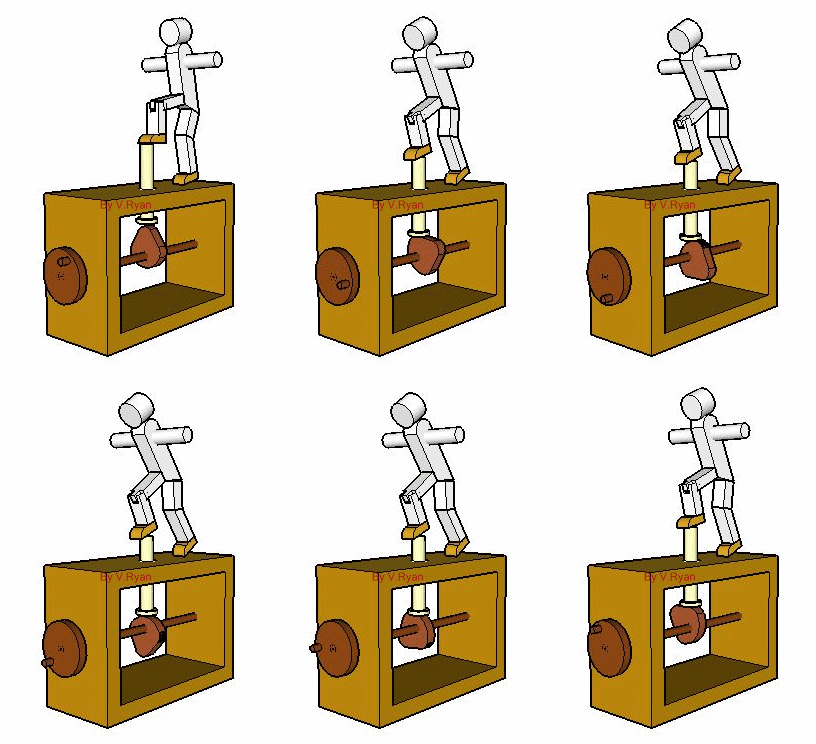
The cam seen below is a 'pear shaped cam'. As the handle is turned the cam profile rotates. The model moves forwards and backwards as a result. The movement is gentle although the faster the handle is turned the faster the movement of the model becomes. |
|
 |
|
|
|
|