|
PDF FILE - CLICK HERE FOR PRINTABLE WORKSHEET It has been known for a long time, that colours influence the way we feel and even our emotions. People often associate colours with happy or sad events. Light colours are known to help people feel more relaxed, whilst dark colours promote a more serious atmosphere. Once it was believed that classroom walls, should be coloured with shades of blues. This colour scheme was thought to promote an atmosphere of learning. What do you think? Try the following experiment: You may be studying a well known book (such as ‘Animal Farm’ or ‘Wuthering Heights’), with a class of English Language pupils. Alternatively, you may be using a text book in Science or an Arithmetic text book in Maths. Ask your teacher if you can temporarily cover the class set of books, with equal numbers of deep blue and bright red covers. Mix up the covered books, so that the books are randomly arranged on a desktop. As the pupils enter the classroom, ask each to pick up a copy of the book. Do not try to influence their selection and do not explain that it is an experiment. If they ask why the books are covered, simply say that each book has a protective cover. You will soon be able to determine which colour is the most popular. |
|
|||||||||||||||
|
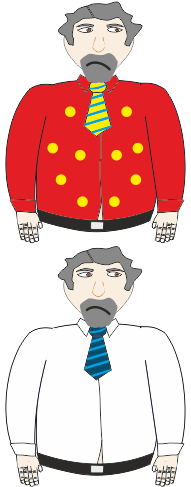
Ed the Handyman must decide which colour is associated with learning. His choice is down to colour alone and not the content of the book. |
||||||||||||||||
|
Has anyone ever said to you that a certain colour suits you? This has probably happened. It has been said, that the colours of our clothes reflect our personality. Try the following experiment: List the names of people in your class and write a short sentence alongside each, stating what you think is their personality. For example, are they outward going, quiet, loud, happy, often angry etc.... Then, ask each pupil, what their favourite colour is. Are those people who are happy associated with a particular colour? Are those pupils who are quiet associated with a particular colour. To find out if there is a link between favourite colour and personality, you may have to list at least 100 pupils or even more. The more people you ask, the more interesting the findings of the survey. Social Scientists state that people who favour red are more ‘pushy’ and forthright. On the other hand, people wearing blue, are more likely to be quiet and reserved. Do you think this is right? |
|
|||||||||||||||
|
Ed the Handyman businessman and owner of 'Colour World' - Remember, the colours we choose can determine the way people view us. Will Ed conform to ordinary business colours rather than vibrant colours? |
||||||||||||||||
|
||||||||||||||||
|
Experiment: |
||||||||||||||||
|
|
||||||||||||||||